

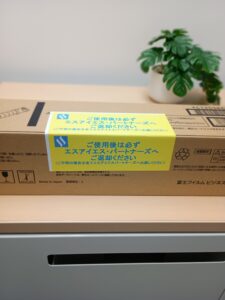
Case Study: Recycled Toner Program Designed Backward from Used-Cartridge (Core)
Compatible Printer
Manufacturer: FUJIFILM Business Innovation
Model: ApeosPrint C5575
Spec: A3 full-color laser printer, 55 ppm (same speed for color/mono)
Duty cycle: 1.5M pages or 5 years (whichever comes first)
Delivery Info
Customer: Medical institution (Aichi, Japan)
Delivery No.: 26011901
Customer Challenge (As-Is)
The customer wanted to continue using remanufactured (recycled) toner after a color laser printer refresh. However, the target model has low market penetration, so used cartridges (cores) required for remanufacturing could not be sourced, making program launch impossible from a supply-chain standpoint.
They considered compatible cartridges, but rejected them due to concerns about long-term availability, lot consistency, and quality reproducibility. Operationally, they required no change between OEM purchasing and recycled-toner purchasing. As a medical site, downtime was unacceptable; stock-out prevention and high uptime were mandatory.
Our Design (To-Be)
Ramp-up: Start with OEM to build a closed-loop core cycle
We proposed starting with OEM toner to intentionally generate OEM used cores. The goal was a closed-loop flow: OEM use → core collection → remanufacturing → re-deployment.
Demand planning and inventory design
Based on legacy device consumption and actual print volume, we quantified monthly usage, lead time, safety stock, and required inventory across three layers (customer stock / our stock / factory stock). We also calculated the core volume needed to sustain recycled-toner operations, eliminating core shortage as the bottleneck.
Collection scheme: Reverse logistics to prevent collection leakage
Because the customer planned to install OEM MFPs as well, cores could be diverted into the manufacturer take-back channel. We therefore defined a clear reverse-logistics route and standardized rules to avoid leakage: target identification (by model/color/conditions), standardized collection flow (bins, timing, storage), clear responsibility points, and a zero-loss collection design to keep the cycle running.
Benefits (Effect)
Faster transition: minimized time lag to recycled-toner operation
Lower TCO/LCC: reduced OEM dependency and optimized running cost over long-term use
No operational disruption: minimal process change for frontline staff
Reduced stock-out and downtime risk: multi-tier inventory plus safety stock
Higher uptime: reduced risk of print stoppage in clinical workflows
Why Us
We supply materials and components, including toner powder, to remanufacturing partners. This enables end-to-end optimization of device selection, media compatibility, and operational design based on consumable quality characteristics and hardware behavior.
In color printing, recycled-toner penetration is about 12% per AJCR, reflecting not only quality challenges but also operational hurdles (core sourcing, reverse logistics, lot stability, inventory and supply). With a high share of color-printer volume in our business, we have accumulated practical know-how to stabilize supply and support both launch and steady-state operations.